At its heart, a scissor lift is a straightforward machine designed for one primary job: lifting workers, tools, and materials straight up. Think of it as a mobile, heavy-duty patch of floor that you can send skyward, creating a stable workspace at height. It’s an absolute workhorse for countless construction, maintenance, and warehousing tasks.
What Exactly Is a Scissor Lift?
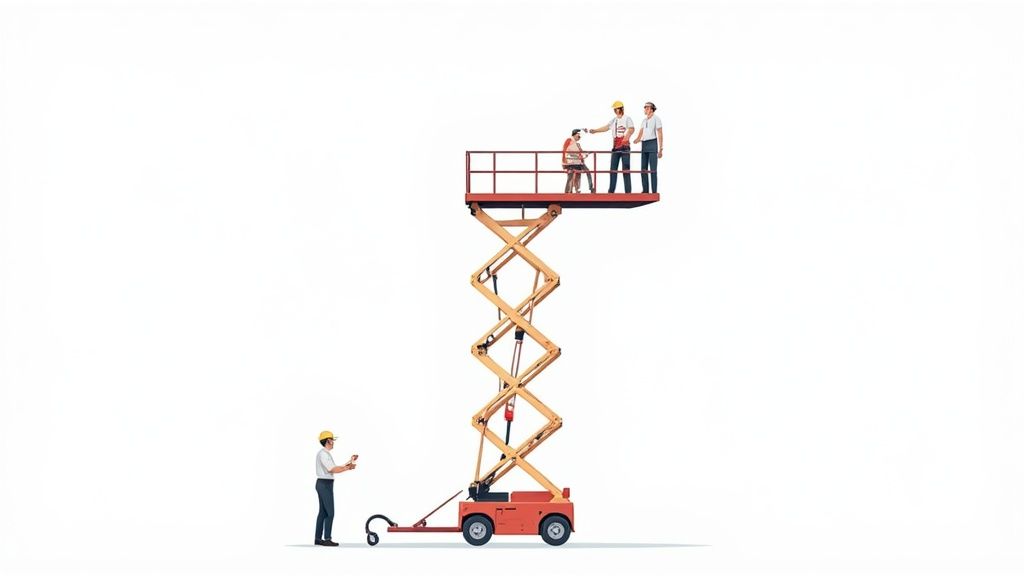
Picture this: you need to work on a high ceiling. A ladder gets one person up there, but it’s wobbly and offers zero room for tools. Scaffolding is solid, but it’s a pain to set up and impossible to move once it’s built. The scissor lift was born to solve exactly this problem, combining the stability of scaffolding with the get-up-and-go of a vehicle.
Every scissor lift, big or small, is built on three core components. It starts with a wheeled base, which gives it a solid footing and lets you drive it right to the job. Connected to that is the iconic stack of crisscrossing metal supports, often called "scissor legs" (or a pantograph, if you want to get technical). And on the very top, you have the spacious work platform, fully enclosed by guardrails for safety.
How It Goes Up
When you hit the controls, hydraulic fluid floods into cylinders, which pushes the scissor legs apart. This accordion-like expansion is what drives the platform smoothly and directly upward. The genius of the design is that it keeps the platform perfectly level and centered right over the base, making for an incredibly secure place to work.
This straight-up-and-down movement is the defining feature of a scissor lift. It’s what separates it from other aerial lifts like boom lifts, which have arms that can reach up and over obstacles.
A scissor lift's real superpower is its platform. It gives you a large, stable deck in the sky, turning what would be a sketchy high-reach job into a manageable workstation. It’s big enough for multiple workers to operate side-by-side with all the gear they need.
An Indispensable Tool Across Industries
From warehouses to construction sites, the scissor lift has become a cornerstone of modern work. You just can’t beat its blend of safety and efficiency. This isn't just an observation; the numbers back it up. The global market for scissor lifts was pegged at around USD 3.52 billion in 2024 and is expected to climb to nearly USD 10.04 billion by 2037.
With an estimated 10 million factories worldwide, the demand for safe vertical access isn't going anywhere. For a deeper dive into these market trends, the scissor lift market research from Research Nester is a great resource.
So, when you ask what a scissor lift is used for, the answer is simple. It's for any job that needs a safe, sizable, and mobile platform at height. Period.
Where Scissor Lifts Shine in Key Industries
While the idea of a mobile, vertical platform seems simple, its real-world applications are anything but. A scissor lift isn't just another piece of equipment; it's a problem-solver that puts a secure, elevated workspace exactly where you need it. From chaotic construction sites to the quiet aisles of a warehouse, its stability and spacious platform make it the clear winner over shaky ladders or stationary scaffolding.
Every industry plays to a scissor lift's strengths in different ways. In one setting, it’s all about brute force and outdoor grit; in another, it’s about silent, emission-free precision in tight spaces. By walking through these scenarios, we can see what these machines are really used for on the ground.
The Backbone of Construction Sites
Nowhere is the scissor lift more at home than on a construction site. These rugged environments demand equipment that can handle tough jobs safely and efficiently, and the construction industry is by far the heaviest user of these machines.
In fact, construction dominates the market, making up roughly 54.7% of global usage. The market, valued at USD 3.1 billion, is expected to hit USD 4.4 billion by 2035, with the most common lifts being those that reach heights of 30 to 50 feet. You can dig deeper into these numbers by checking out these insights on scissor lift market trends.
On-site, these lifts are indispensable for all sorts of high-reach work:
- Electrical and HVAC Installation: An electrician can load their entire toolkit and all the necessary parts onto the platform. This lets them run conduit, install fixtures, and connect ductwork without constant trips up and down a ladder.
- Welding and Steel Framing: The lift’s rock-solid base is critical for precision tasks like welding structural beams. It provides a secure zone for both the welder and their heavy gear.
- Exterior Finishing: Whether it's painting, siding, or installing windows, the large platform lets multiple workers cover wide areas at once, seriously speeding up project timelines.
An Efficiency Boost in Warehousing and Logistics
Step inside any modern warehouse or distribution center, and you'll probably spot a sleek electric scissor lift gliding down an aisle. In the fast-paced world of logistics, vertical space is money, and these machines are the key to cashing in on it.
Unlike their rough-and-tumble construction cousins, warehouse lifts are almost always electric. They're prized for their quiet, zero-emission operation and non-marking tires that won't scuff up finished concrete floors. Their compact size lets them navigate narrow aisles with ease, making them perfect for precise inventory work.
For a warehouse manager, a scissor lift isn't just a lift—it's a tool for operational velocity. It turns high-density storage from a logistical headache into a smooth process, making picking and stocking much faster.
Key tasks in a warehouse setting include:
- High-Rack Stocking and Retrieval: Operators can safely lift heavy pallets or individual boxes to top-tier shelving, making the most of every cubic foot of storage.
- Order Picking: For bulky or heavy items stored up high, an employee can go straight up to the product, pick it safely, and bring it down for transport.
- Inventory Management: Doing cycle counts or stock checks on high shelves becomes a quick and accurate job when your team can work comfortably at eye level with the inventory.
The Unsung Hero of Facility Maintenance
Beyond the job site and the warehouse, scissor lifts are the workhorses of ongoing upkeep for large buildings. Facility maintenance teams in places like convention centers, airports, arenas, and manufacturing plants with soaring ceilings rely on them daily.
In this world, a scissor lift offers a safe and practical alternative to building complex scaffolding for a job that might only take an hour. Think about it: changing a single burnt-out bulb in a 40-foot ceiling is impossible with a ladder and complete overkill with scaffolding. A scissor lift hits that sweet spot, offering quick setup and a safe working platform.
Common maintenance jobs include changing light fixtures in high-ceiling venues, cleaning multi-story windows from the inside, and accessing elevated HVAC units, fire sprinklers, or security cameras for repairs. For these crews, the scissor lift is simply part of the daily grind.
How to Choose the Right Scissor Lift for Your Task
Picking the right scissor lift is a lot like choosing the right tool from your toolbox. You wouldn't use a sledgehammer for a finishing nail, right? Matching the machine to the job site is the single most important step you can take to ensure a safe, efficient workday.
The biggest fork in the road is deciding between indoor and outdoor work. This one choice immediately points you toward one of two main categories: electric scissor lifts or rough-terrain scissor lifts. Get this right, and you'll prevent delays, avoid damaging property, and give your crew the exact machine they need to get the job done.
Electric Lifts for Indoor Precision
When your work is inside a finished building—think warehouses, convention centers, or retail stores—an electric scissor lift is your best bet. These machines are built specifically for smooth, flat surfaces like concrete floors. They run on powerful batteries, which means they're nearly silent and produce absolutely zero emissions.
That clean, quiet operation makes them perfect for environments where noise levels and air quality are non-negotiable. Plus, they almost always come with non-marking tires, so you don’t have to worry about leaving scuffs or black streaks all over a polished floor. Since they're battery-powered, a solid charging routine is a must. You can find a wide range of dependable scissor lift battery chargers designed to keep your fleet powered up and ready to go.
Rough-Terrain Lifts for Outdoor Power
Once you step outside, the game completely changes. Construction sites are rarely flat, clean, or predictable. You're dealing with mud, gravel, and uneven ground. This is where a rough-terrain scissor lift shines. These beasts are usually powered by diesel engines, giving them the raw torque needed to power through challenging conditions.
They come loaded with features built for the outdoors:
- Four-wheel drive (4WD) for getting a grip on dirt and mud.
- Deep-tread, heavy-duty tires that chew through uneven surfaces.
- Higher ground clearance to roll over debris and obstacles.
- Stabilizing outriggers on many models to create a solid, level base even on a slope.
This graphic really helps visualize where each type of lift fits best.
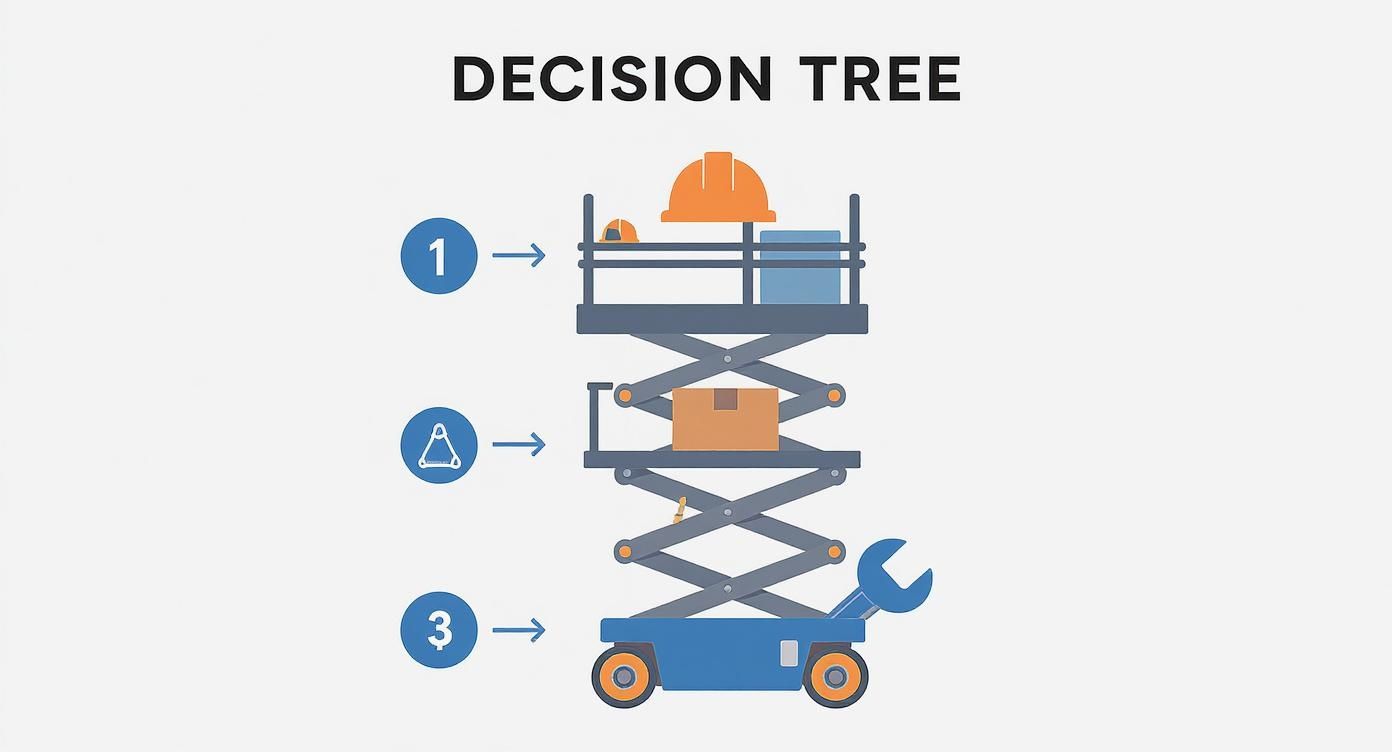
As you can see, it all comes back to a simple rule: the job site dictates the machine.
To make the choice even clearer, here's a quick side-by-side comparison.
Electric vs Rough-Terrain Scissor Lifts at a Glance
| Feature | Electric Scissor Lift | Rough-Terrain (Diesel) Scissor Lift |
|---|---|---|
| Power Source | Battery (Rechargeable) | Diesel or Dual Fuel (Gas/Propane) |
| Ideal Terrain | Smooth, flat, level surfaces (concrete, asphalt) | Uneven, muddy, or rough ground |
| Environment | Indoors | Outdoors |
| Emissions | Zero | Produces exhaust fumes |
| Tires | Non-marking, solid or foam-filled | Deep-tread, foam-filled, pneumatic |
| Noise Level | Very quiet | Loud engine noise |
| Gradeability | Low (typically climbs slight ramps only) | High (designed for slopes and inclines) |
| Key Advantage | Clean, quiet, and compact for tight spaces | Power, traction, and stability on tough sites |
This table lays out the fundamental differences, making it easier to see why picking the right power source for your environment is the crucial first step.
Key Specifications Beyond Power Source
Once you’ve settled on electric or rough-terrain, it’s time to look at the hard numbers. Matching the lift’s specs to your specific task is non-negotiable for both safety and efficiency.
Choosing a scissor lift isn't just about how high it goes. It’s about making sure the platform can safely handle your crew, their tools, and all the materials needed to do the job without ever pushing its limits.
Here are the three critical specs you absolutely have to get right:
- Platform Height: This is how high the platform floor can get. But what you really need is the "working height," which is typically 6 feet higher to account for an operator’s reach. Always pick a lift with a working height that’s a few feet more than the highest point you need to access.
- Weight Capacity: This is the total combined weight the platform can safely hold—that includes people, tools, materials, everything. Don't guess. Add up the exact weight of every single thing that will be on that platform to avoid a dangerous overload situation.
- Platform Dimensions: This is simply the size of the workspace. A bigger platform might let you get more done with more people or materials, but a smaller one can navigate tight corners and narrow aisles. Also, ask yourself if you’ll need a platform extension; many models have slide-out decks for a bit of extra horizontal reach.
As more job sites face stricter rules on noise and emissions, electric models are becoming more popular. In fact, electric scissor lifts are projected to account for about 63.1% of market revenue, driven by their clean operation. By thinking through the job site and these core numbers, you can confidently choose a scissor lift that's a perfect fit for the task at hand.
Mastering Scissor Lift Safety and OSHA Compliance
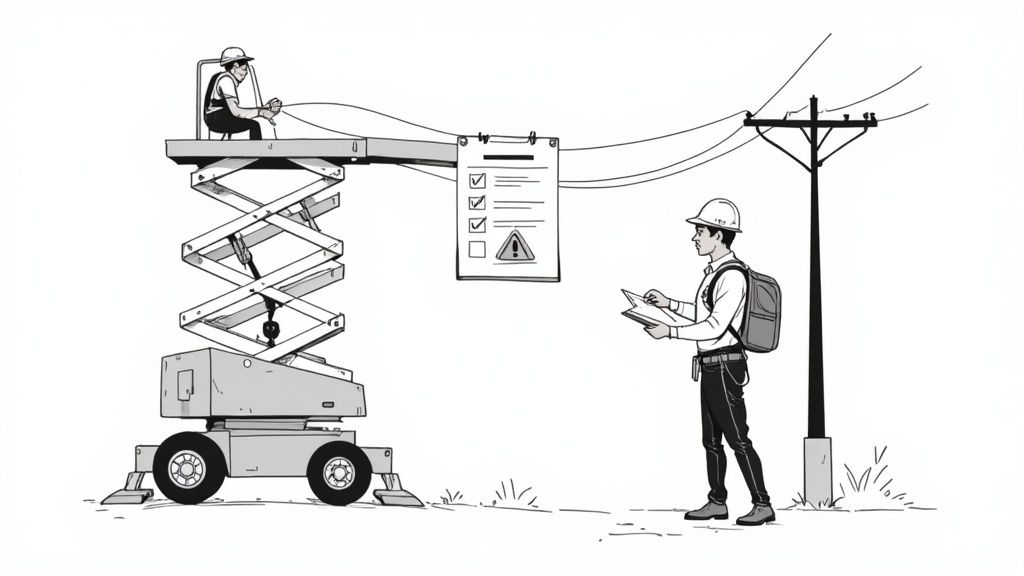
Putting heavy machinery in the air is serious business, and scissor lifts are no exception. It’s not just about getting the job done—it’s about making sure every single person on site goes home safely. That commitment is backed by strict, non-negotiable guidelines from the Occupational Safety and Health Administration (OSHA).
Following these rules isn't just good practice; it’s a legal requirement designed to prevent the worst from happening. The most common incidents—tip-overs, falls, and electrocutions—are almost always preventable with solid training and daily safety diligence.
The Daily Pre-Operation Inspection
Before any scissor lift starts its engine, the operator must conduct a full pre-operation inspection. This is your first line of defense against equipment failure. Think of it as a pilot's walk-around before a flight; it’s a non-negotiable step that catches small problems before they become big ones.
This daily check is a systematic process, covering every critical component to ensure the machine is fit for duty.
Your inspection should always include:
- Fluid Levels: Check hydraulic oil, engine oil, and coolant. Are they at the manufacturer's recommended levels?
- Tires and Wheels: Look for damage, excessive wear, or improper inflation. Any of these can throw off the lift's stability.
- Controls: Test every operating control. This includes emergency stop buttons and descent mechanisms. Make sure they function exactly as they should.
- Safety Features: Are the guardrails secure? Do the safety alarms work? Are all safety decals present and legible?
Identifying and Mitigating Workplace Hazards
Once the machine gets the green light, the focus shifts to the work area. A perfectly functional lift can become incredibly dangerous in the wrong environment. Spotting potential hazards is just as critical as inspecting the equipment itself.
Operators need to be trained to recognize and react to changing site conditions all day long. This constant awareness is what keeps people safe.
A safe worksite is a planned worksite. Never raise the platform without first analyzing the ground below, the space around, and the area above the lift. This 360-degree awareness is the hallmark of a professional operator.
Key hazards to watch for include:
- Unstable Ground: Never operate on soft, uneven, or sloped ground. The only exception is a rough-terrain model that has been specifically designed and properly leveled for it.
- Overhead Obstructions: Always be aware of power lines, pipes, and structural beams. The minimum safe distance from power lines is 10 feet, and that distance grows with higher voltages.
- Drop-offs and Holes: Keep a wide berth from ditches, manholes, or any unprotected edges. A single wheel dropping into a hole can destabilize the entire lift.
- Weather Conditions: High winds and lightning are deal-breakers. Every lift has a maximum wind speed rating from the manufacturer, and it must be respected to prevent tip-overs.
The Importance of Training and Certification
You wouldn't hand the keys to a company truck to an unlicensed driver, and the same logic applies here. OSHA standard 29 CFR 1910.178 is clear: all scissor lift operators must be trained and certified on the specific model they'll be using.
This isn't just a quick rundown of the controls. Formal training covers the machine’s load capacity, stability factors, inspection procedures, and what to do in an emergency. For companies aiming to build a true culture of safety, a comprehensive scissor lift safety program is an essential step. Proper certification is the foundation, ensuring every operator knows exactly what a scissor lift is used for and, more importantly, how to use it right.
Deciding Between Renting and Buying Your Scissor Lift
It's one of the biggest questions every business with height access needs has to tackle: should you add a scissor lift to your permanent fleet or just rent one when a project calls for it? There’s no simple answer here. The right move depends entirely on your company's workflow, budget, and what you’re planning for the long haul.
Get this decision wrong, and you could end up with precious capital tied up in a machine that collects dust, or worse, scrambling to find a rental when a deadline is looming. The key is to take a hard, honest look at how often you really need a lift. Making a smart choice here will directly impact your bottom line and keep your operations running smoothly.
When Renting Makes Financial Sense
For a lot of businesses, renting is hands-down the most practical option. If your need for a scissor lift is just for a few specific jobs a year, renting gives you access to top-tier equipment without the massive upfront cost of buying. This keeps your cash free for other parts of the business.
Renting also means you get to skip all the headaches of ownership. You don't have to worry about:
- Maintenance and Repairs: The rental company is on the hook for everything, from routine checks to fixing a sudden breakdown.
- Storage: Once the job’s done, you send it back. No need to sacrifice valuable yard or warehouse space to park a big piece of machinery.
- Specialized Needs: Need a big 45-foot rough-terrain model for one job and a nimble little electric lift for the next? Renting lets you pick the perfect tool for each specific task.
The rental market is booming for a reason. The global scissor lift rental market was valued around USD 9.2 billion and is expected to hit USD 13.5 billion by 2035. Electric models are leading the charge, making up about 65% of the market, which tells you a lot about the demand for efficient, quiet machines. You can find more details on scissor lift rental market trends.
The Case for Buying Your Scissor Lift
On the flip side, if a scissor lift is basically a member of your daily crew, buying one is a powerful long-term play. Sure, the initial check you write will be bigger, but if you're using it all the time, ownership quickly starts paying for itself by cutting out those never-ending rental bills.
Owning your scissor lift transforms it from a temporary tool into a permanent asset. The convenience of having equipment on-site and ready to deploy at a moment's notice can provide a significant competitive advantage.
The real wins from buying come down to these three things:
- Long-Term Cost Savings: Over the life of the machine, the total cost of ownership will almost always be lower than what you'd spend on frequent rentals.
- Constant Availability: Your machine is always there. No more waiting for a rental delivery to show up. Your team can stay on schedule and keep working.
- Potential Tax Advantages: Buying equipment can open the door to tax benefits, like depreciation deductions, that help soften the blow of the initial purchase price.
At the end of the day, it's a simple cost-benefit analysis. Add up what you expect to spend on rentals over a year and stack that number up against the price of buying and maintaining a new or used lift.
If you're still weighing the options and need a little expert advice on what a scissor lift is used for in your specific industry, our team is here to help. Feel free to get in touch with our equipment specialists, and we can walk you through the numbers to find the most cost-effective solution for your business.
Got Questions? We've Got Answers.
Even after you get the hang of what a scissor lift does, a few specific questions always pop up. We've heard them all. This is where we tackle the most common ones with straightforward answers to clear up any confusion before you get to work. Think of it as a quick reference for those last-minute "what-if" moments on the job site.
Do You Need a License to Operate a Scissor Lift?
Yes, absolutely. This isn't a suggestion; it's a hard rule. In the United States, OSHA is crystal clear on this: anyone operating an aerial work platform, including a scissor lift, has to be trained and certified on the specific machine they're using.
It's not like a driver's license that covers any car you hop into. Your certification proves you know the ins and outs of that specific lift—its controls, its limits, and the critical safety steps needed to keep everyone safe.
What Is the Main Difference Between a Scissor Lift and a Boom Lift?
It all comes down to how they move. A scissor lift is a one-trick pony, but it's a great trick: it only goes straight up and down. This gives you a big, stable platform for jobs that are directly overhead. Simple and effective.
A boom lift, on the other hand, has an extendable arm that gives you both height and horizontal reach. That arm is the game-changer, letting you work up and over obstacles on the ground.
Simple rule of thumb: If you can park right under your work area, you need a scissor lift. If you have to reach over something to get there, you need a boom lift.
Can You Use a Scissor Lift on a Slope?
This is a big one, and the answer depends entirely on the machine. A standard electric slab scissor lift is built for one thing: firm, perfectly level surfaces. Trying to use one on even a slight incline is a recipe for a tip-over and a major safety violation. Don't do it.
However, rough-terrain models are engineered for exactly this problem. They come equipped with heavy-duty features like four-wheel drive and stabilizing outriggers that let you level the machine on uneven ground or minor slopes. Always, always check the manufacturer's spec sheet to know the lift's exact gradeability limits.
How High Can a Scissor Lift Go?
The height range is massive. A compact electric model you'd see inside a warehouse for changing lightbulbs might only give you a working height of 15-20 feet.
On the other end of the spectrum, a big diesel-powered rough-terrain scissor lift for a major construction site can reach working heights of 50 feet or even more. The height you need is one of the very first things you have to nail down when deciding which machine to rent or buy.
Whether you need a specific part to get your machine back in service or are looking to rent the right lift for your next job, Flat Earth Equipment has the technician-led expertise and dispatch-ready inventory to keep your fleet moving. Explore our solutions at https://flatearthequipment.com.