Figuring out your telehandler rental budget can feel a bit like aiming at a moving target. To give you a solid starting point, rental rates for smaller models generally run between $300 and $800 per day. If you need a beast of a machine with serious lifting power, you could be looking at $1,500 to $2,500 per day, or even more.
The good news? Just like booking a longer hotel stay, weekly and monthly rentals come with some pretty hefty discounts. For any project that isn’t a quick in-and-out job, locking in a longer term is almost always the smarter financial move.
A Quick Guide to Telehandler Rental Rates
When you're putting a project budget together, equipment costs are one of the biggest line items. Think of renting a telehandler like you'd think about renting a car for a trip. A compact sedan for a weekend city trip has a very different price tag than a heavy-duty truck you need for a month-long cross-country haul.
The same logic applies here. A compact telehandler for a small residential build is priced differently than a massive, high-reach machine needed for a multi-story commercial project. To help you nail down your numbers, let's break down what you can generally expect to pay.
Estimated Rental Rates by Machine Size
The biggest dial that turns the price up or down is the machine's muscle—its lift capacity and reach. A smaller 6,000 lb capacity telehandler is often the go-to for residential job sites, but for serious industrial work, you’ll need to step up to a 12,000 lb model or larger.
Here’s a look at some typical rental quotes to help you get started.
| Telehandler Size (Lift Capacity) | Estimated Daily Rate | Estimated Weekly Rate | Estimated Monthly Rate |
|---|---|---|---|
| Compact (5,000 - 6,000 lbs) | $300 - $550 | $900 - $1,600 | $2,500 - $4,500 |
| Standard (8,000 - 10,000 lbs) | $450 - $800 | $1,500 - $2,500 | $4,000 - $7,000 |
| High-Capacity (12,000+ lbs) | $700 - $1,500+ | $2,200 - $4,000+ | $6,500 - $12,000+ |
Heads Up: Treat these numbers as a ballpark for your initial budget. Your final quote will shift based on your exact location, the specific machine model, any attachments you need, and what the local market demand looks like.
It's also worth noting that demand is high, and prices are on the move. The construction boom has been pushing equipment rental costs up across the board. For example, recent industry data showed the average weekly telehandler rental rate in the U.S. jumped by 12.43% to $2,103. You can dig into the trends on rising equipment rental rates over at EquipmentWorld.com.
What does that mean for you? Get your quotes locked in early, especially if you’re working during the busy construction season when machines are scarce and prices peak.
What Actually Drives Your Rental Cost
Beyond the sticker price you see in a table, several key factors work together to determine what you'll actually pay for a telehandler rental. Think of it like booking a flight. The base fare is just the start; the final price shifts based on your seat choice, baggage, travel dates, and how far out you book. Getting a handle on these variables is the first real step toward mastering your project's equipment budget.
Renting equipment isn't a niche strategy anymore; it's the go-to for a huge number of construction and industrial operations. The global market shows just how big this trend is, with projections showing that rental services will make up 57.8% of the total telehandler market revenue by 2025. This heavy reliance on rentals makes it even more critical to understand exactly where your money is going.
This chart breaks down how rental periods typically affect your rates.
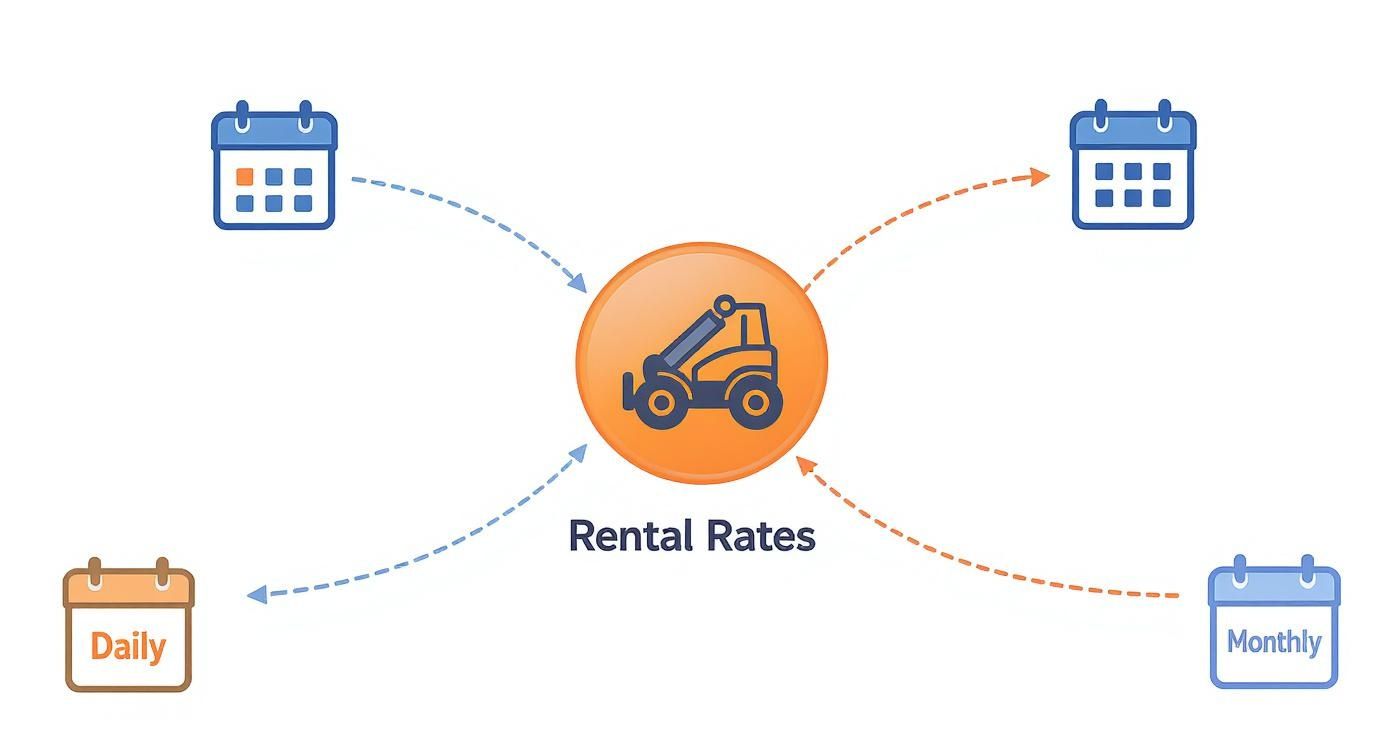
As you can see, the longer you commit, the more you save. Stretching your rental from a daily to a weekly or monthly term drops the per-day cost significantly, creating some nice economies of scale for your project.
Machine Size and Capability
The biggest cost driver, without a doubt, is the machine's raw size and power. A compact telehandler with a 6,000-pound lift capacity and a 20-foot reach is a completely different beast—with a different price tag—than a heavy-duty model built for 15,000 pounds with a 56-foot reach.
Simply put, bigger machines cost more. It’s not just about more steel; it’s about the machine's initial purchase price, its more intensive maintenance needs, and the logistics of getting it to you. All of that gets baked into the rental rate.
Lift Capacity: How much can it safely pick up? The higher the number, the higher the rate.
Maximum Reach: How high or far can the boom go? More reach requires more complex engineering and a bigger, heavier chassis for stability, which drives up the cost.
If you rent a machine that's way oversized for your task, you're just paying for power you'll never touch. But on the flip side, underestimating your needs can lead to brutal delays or an expensive, last-minute scramble to get a bigger unit on-site.
Specialized Attachments
A telehandler's magic is its versatility, which comes from swapping out attachments. But that flexibility isn't free. Your base rental rate almost always covers just the standard fork carriage. Every other tool you need is an add-on that bumps up your daily, weekly, or monthly cost.
A telehandler without the right attachment is like a smartphone without apps—all the potential is locked away. You have to budget for these tools from the get-go if you want an accurate cost plan.
Common attachments that will add to your invoice include:
Work Platforms: For lifting people safely to height.
Material Buckets: For scooping and moving loose stuff like gravel or dirt.
Truss Jibs: For lifting and placing trusses, frames, and other rigged loads.
Grapple Buckets: For grabbing and moving awkward materials like logs or demolition debris.
Rental Duration and Logistics
The length of your rental term creates major price breaks. Rental companies give you a better deal for longer commitments because it guarantees their machine is working and cuts down on their own administrative and transport costs. A monthly rental will almost always give you the cheapest effective daily rate.
Don't forget about logistics. Delivery and pickup fees are standard practice, and they're calculated based on how far your job site is from the rental yard. To get a feel for how these costs are broken down, it's helpful to look at how pros approach understanding the real cost of shipping a vehicle; they dissect every single factor that contributes to the final price.
The logic is the same for heavy equipment: distance, machine size, and scheduling all influence the final transport fee. This will be a separate line item on your bill, so always get a firm quote for these round-trip charges before you sign anything.
Uncovering the Hidden Costs in Your Rental Quote
That base rental rate on your quote? Think of it as the sticker price on a car—it’s the starting point, but it's never the full story. If you’re new to renting heavy equipment, the final invoice can be a bit of a shock when you see all the extra line items you didn't budget for.
These aren't "hidden" fees in a sneaky way; they're just the standard, operational costs of getting a massive piece of machinery to your site and keeping it protected. But if you don't know to ask about them, they can definitely feel like a surprise. Let's pull back the curtain so you can build a budget that reflects reality.

Transportation and Delivery Fees
Unless you happen to own a heavy-haul trailer and have all the right permits, that telehandler isn't just going to show up on its own. Delivery and pickup fees are a standard part of every rental and are almost always a separate charge.
The cost is usually tied directly to the distance from the rental yard to your job site. A quick trip across town might run you $150-$250 each way. But if you're working on a remote site, that fee could easily jump to $500 or more, depending on the miles and road conditions. Always, always get a firm round-trip transportation quote upfront.
Fuel Policies and Charges
Telehandlers are thirsty, and how you handle the fuel can make a real dent in your final bill. Rental companies have very specific fuel policies you need to understand from the get-go.
Return Full: This is the most common setup. The machine arrives with a full tank, and you’re expected to return it the same way. If you don’t, the rental company will gladly top it off for you—at a premium price that's way higher than what you'd pay at the local gas station.
Fuel Surcharge: Some companies might add a flat fuel surcharge or bill you for what you used based on the machine's hour meter.
Plan on refueling the telehandler yourself right before it gets picked up. It's a small chore that can save you from paying an extra $2-$3 per gallon.
Insurance and Damage Waivers
No rental company is going to hand over a piece of equipment worth tens of thousands of dollars without making sure it's protected. You’ll be required to show proof of proper insurance before that machine ever leaves their yard.
You'll need to provide a Certificate of Insurance (COI) that names the rental company as an "additional insured." This simply proves you have enough liability and property damage coverage. For a closer look at managing risk on-site, our guide to equipment safety protocols is a great resource.
Many rental houses also offer an optional Loss Damage Waiver (LDW). This isn't insurance. It’s an agreement where, for a fee (usually 10-15% of the rental rate), they agree not to charge you for some types of accidental damage. Read the fine print, because it almost never covers things like negligence, theft, or obvious misuse.
Overtime and Operator Costs
Your rental agreement will clearly state the machine's usage limits. A standard "day" is typically 8 hours of use, a "week" is 40 hours, and a "month" is 160 hours. If you go over those hours on the meter, you're going to get an overtime bill.
Overtime is usually pro-rated at an hourly rate, but sometimes it comes at a premium. If you know your project will involve double shifts or long days, talk to the rental company about it beforehand. They might have a high-usage plan that could save you money.
Finally, if you don't have a certified telehandler operator on your team, you'll need to hire one. This can often be arranged through the rental company or a third party. Expect to pay an hourly rate anywhere from $50 to over $100 per hour, based on your location and the operator's experience.
How Location Impacts Telehandler Rental Prices
Ever wonder why renting the exact same telehandler in a booming city costs a whole lot more than in a quiet, rural town? It all comes down to one of the biggest factors in telehandler rental rates: your project's zip code. Just like real estate, equipment rental costs can swing wildly from one location to the next.
This isn't just a random price hike; it’s a direct reflection of what's happening on the ground. A region in the middle of a construction boom will have sky-high demand for machinery, pushing prices up as rental companies scramble to keep up. On the flip side, in a slower market, those same companies might drop their prices to stay competitive and keep their gear from collecting dust.
The Dynamics of Supply and Demand
At its heart, regional pricing is a classic story of supply and demand. In a fast-growing metro area, every new high-rise, housing development, and infrastructure project is competing for a limited number of available telehandlers. That fierce competition gives rental companies serious pricing power.
Meanwhile, a rural area with fewer big projects has a much more balanced market. With less demand in the air, rental outfits have to offer better rates to win your business.
Key Takeaway: Never assume a "national average" rate applies to your job. Local economic conditions are the single biggest variable that can swing your rental quote by hundreds or even thousands of dollars per month.
Don't forget about logistics. A rental yard in a dense urban core is paying more for property taxes, labor, and just about everything else. Those higher overhead costs get baked right into the prices you pay.
Regional Market Spotlights
The impact of location really hits home when you compare different markets. In the United States, for example, strong construction activity has led to some pretty aggressive growth in rental rates. Fierce competition for equipment in hubs like Dallas or Phoenix means you'll almost certainly see higher quotes than you would in a more stable, less frenetic market. Booking your machine early is key.
In contrast, the European market is telling a different story. According to the International Powered Access Federation (IPAF), rental rates for telehandlers and similar equipment saw only a modest 1% rise in 2024. This was mainly led by Nordic countries (2–3%), while major markets like Germany and France actually felt some downward pricing pressure. You can dig into the details in the 2025 rental market reports from IPAF.
These global differences make it clear: a "one-size-fits-all" price just doesn't exist. Your project's location determines the market forces you'll be up against.
Booming Metro Areas: Be ready for higher rates, tighter availability, and the need to book further out.
Stable or Rural Regions: You'll probably find more competitive pricing and have an easier time finding an available machine.
No matter where your job site is, one thing is universal: making sure your operators are properly trained is non-negotiable. For anyone in the Golden State, our guide on California forklift certification requirements is a great resource, with safety principles that apply to most heavy equipment. The absolute best way to navigate these regional price differences is to get multiple quotes from local suppliers. It's the only way to get a true feel for what "fair market value" really means in your area.
Proven Strategies to Lower Your Rental Bill
Knowing what drives telehandler rental rates is one thing; learning how to control them is where the real money is saved. Savvy project managers know not to just accept the first quote that lands in their inbox. They get proactive, using a few smart strategies to manage costs, lock down equipment, and make every rental dollar work harder for their project.
These aren't complicated tricks, but they do require a bit of foresight and a solid handle on your project's actual needs. From how you schedule your rental to the terms you agree on, a few key decisions can make a huge difference to your final bill. Let's walk through the proven methods you can use to lower your costs without ever compromising on-site performance or safety.
Plan Ahead and Book Early
If there’s one golden rule for saving money, it’s this: avoid last-minute rentals. In the world of equipment rentals, spontaneity is a budget-killer, especially during the peak spring and summer construction seasons when demand for telehandlers goes through the roof.
Booking your machine several weeks—or even a month—ahead of time accomplishes two critical things. First, it guarantees availability, so you get the exact machine you need, right when you need it. Second, it often locks in a lower rate before that seasonal demand surge sends prices climbing.
Rental companies reward planners. When they can accurately forecast their inventory, they often pass those logistical savings right back to you with a better rate.
Right-Size Your Machine for the Job
It’s easy to fall into the "just in case" trap and rent a bigger, beefier telehandler than you actually need. This is one of the most common ways projects bleed money. You’re essentially paying a premium for capacity and reach that will sit unused.
Before you even think about requesting a quote, get crystal clear on your job's real-world requirements.
Start by answering these questions:
What’s the absolute heaviest load you need to lift? Get a precise number. This sets your minimum lift capacity.
What’s the maximum height and forward reach you’ll require? Break out the tape measure. Know the highest and farthest points your forks will need to touch.
Which attachments are non-negotiable? Don't guess. Confirm if you need forks, a bucket, a truss jib, or a work platform.
When you come to the rental company with these exact specs, their experts can match you with the most cost-effective machine that can safely get the job done. This prevents overspending on an oversized model and—even more importantly—avoids the costly delays caused by renting an undersized one.
Leverage Longer Rental Periods
Like we touched on earlier, rental companies build serious discounts into longer-term rates. The price drop from a daily to a weekly rate is significant, but the savings really kick in when you commit to a full month. The per-day cost can plummet by 50% or more on a monthly term compared to a daily one.
If your project is scheduled to last anywhere near three weeks, always ask for a monthly quote. It’s often cheaper to let the machine sit on-site for a few extra days on a monthly rental than to pay for three separate weekly rentals. This approach also streamlines your logistics and billing, giving you one less thing to worry about.
Your Quote Comparison Checklist
Never, ever settle for the first quote. The only way to know you’re getting a fair market price is to get at least three quotes from different suppliers. But be careful—a low base rate can be deceiving if it’s hiding a bunch of extra fees.
Use this checklist to make sure you're comparing every offer on an apples-to-apples basis. It forces transparency and helps you see the true, all-in cost from each vendor.
| Cost Component | Questions to Ask | Vendor 1 Response | Vendor 2 Response |
|---|---|---|---|
| Base Rate | What is the daily, weekly, and monthly rate for the specified machine? | ||
| Attachments | What is the separate rental cost for each required attachment? | ||
| Transportation | What is the total round-trip fee for delivery and pickup? | ||
| Insurance | Do you offer a Loss Damage Waiver (LDW), and what is the cost? | ||
| Fuel Policy | Is it a "return full" policy, or is there a fuel surcharge? | ||
| Overtime | What are the hourly usage limits, and what is the overtime rate? |
By arming yourself with this level of detail, you can move past the sales pitch and make a truly informed decision. This is how you optimize your budget and set your project up for success.
Common Questions About Renting a Telehandler
By now, you've got a solid handle on how telehandler rental rates are built and what factors move the needle on your final quote. To tie it all together, let's run through some of the questions that pop up most often in the real world.
These are the practical, on-the-ground concerns that can make or break your rental experience. Think of this as your quick-reference guide to navigate the process with confidence and avoid any common headaches.
What Is the Most Cost Effective Rental Period?
Every project manager wants the best bang for their buck, and this question is always top of mind. The short answer? It all comes down to how accurately you can forecast your timeline.
As a general rule, the longer you rent, the lower your effective daily rate sinks. A monthly rental almost always beats a daily or weekly rate on a per-day cost basis. It's just simple economies of scale at work.
For shorter jobs, the math gets a little more interesting. If you know you'll need the machine for three or four days straight, grabbing a weekly rate is often cheaper than paying the higher daily rate for each of those days.
The Smart Approach: Always get quotes for daily, weekly, and monthly periods. If your project is pushing the three-week mark, locking in a monthly rate from the start is usually the smartest move. It gives you a buffer for unexpected delays without getting hit with pricey daily extensions.
Do I Need to Hire a Certified Operator?
Let me make this crystal clear: Yes. Absolutely.
Safety standards, like those from OSHA in the US, mandate that anyone operating a telehandler must be properly trained and certified. This isn't a suggestion; it's a non-negotiable requirement for job site safety and legal compliance.
While some rental outfits might offer their own certified operators for an extra hourly fee, the standard rental agreement assumes you're bringing your own qualified people to the table. It’s your responsibility as the renter to make sure anyone touching the controls has valid, up-to-date certification. Operating without it is not only incredibly dangerous but can also lead to massive fines and could void your insurance if an accident happens.
What Happens If the Telehandler Breaks Down?
Downtime is a project killer, so you need to know the breakdown procedure before you sign anything. The good news is that any reputable rental company bakes maintenance and repair services right into their agreement.
If the machine goes down due to normal wear and tear or a mechanical failure, the rental company is on the hook to fix it. This usually means they’ll send a mobile mechanic to your site or, if it’s a major issue, swap out the machine to get you back up and running.
But the story changes if the damage comes from operator error or clear negligence.
Mechanical Failure: The rental company covers it.
Operator-Caused Damage: You, the renter, are financially liable for the repairs.
If an operator tips the machine, gets in a collision, or damages it through improper use, you can expect a bill for the full cost of repairs and any recovery fees. It's crucial to clarify this liability before you start work. While we're focused on telehandlers here, getting insights into the broader rental company landscape can offer a valuable perspective on how different businesses handle these operational dynamics.
Can I Transport the Machine Myself?
At first glance, picking up the telehandler yourself seems like a slick way to shave a few hundred dollars off the delivery fee. In reality, it's rarely that simple and often not even an option.
Moving a multi-ton telehandler isn't a job for a standard truck and trailer. It demands highly specialized equipment—a heavy-duty, properly rated trailer and a truck with serious hauling power. More importantly, it requires the expertise to load, balance, and secure the machine so it doesn’t become a massive hazard on the road.
A few smaller rental yards might let you handle transport if you can prove you have the right gear and insurance. But the vast majority of larger providers insist on managing delivery themselves. They do this for critical liability and safety reasons. As tempting as it is to cut that line item, letting the pros handle delivery is almost always the safer, smarter choice.
Still have questions or want to talk through the specifics of your project? Our team is always here to help. Reach out to our expert team for personalized guidance and we'll make sure you get the right machine for the job.
At Flat Earth Equipment, we know that uptime is everything. We offer a robust fleet of dispatch-ready rental equipment, transparent pricing, and rapid fulfillment to keep your Western U.S. job sites moving. When you need a reliable machine and expert support, trust us to deliver. Get your fast, no-obligation rental quote today at https://flatearthequipment.com.