If you're wondering how long it takes to get your forklift certification, the short answer is usually just one to two days. That timeframe covers everything you need—from the classroom instruction to the hands-on driving evaluation—to meet safety standards and get to work.
How Long Does Forklift Certification Really Take?
Let's break it down. Getting certified isn't just a single event; it's a two-part process mandated by OSHA. You've got the formal instruction (think of it as the "classroom" part) and the practical evaluation (your "driving test"). How long this all takes really depends on one thing: are you a brand-new operator or just refreshing your existing skills?
For someone new to forklifts, the training is naturally more in-depth. You'll cover safety rules, how the machine works, and how to spot hazards from scratch, which typically fills up a full day or two.
On the other hand, if you're an experienced operator who just needs to renew your certification, the process is much faster. You can often get it done in just a few hours since the focus is on new regulations and a quick confirmation of your driving skills.
This visual gives you a quick look at the time difference between getting certified for the first time and just getting a refresher.
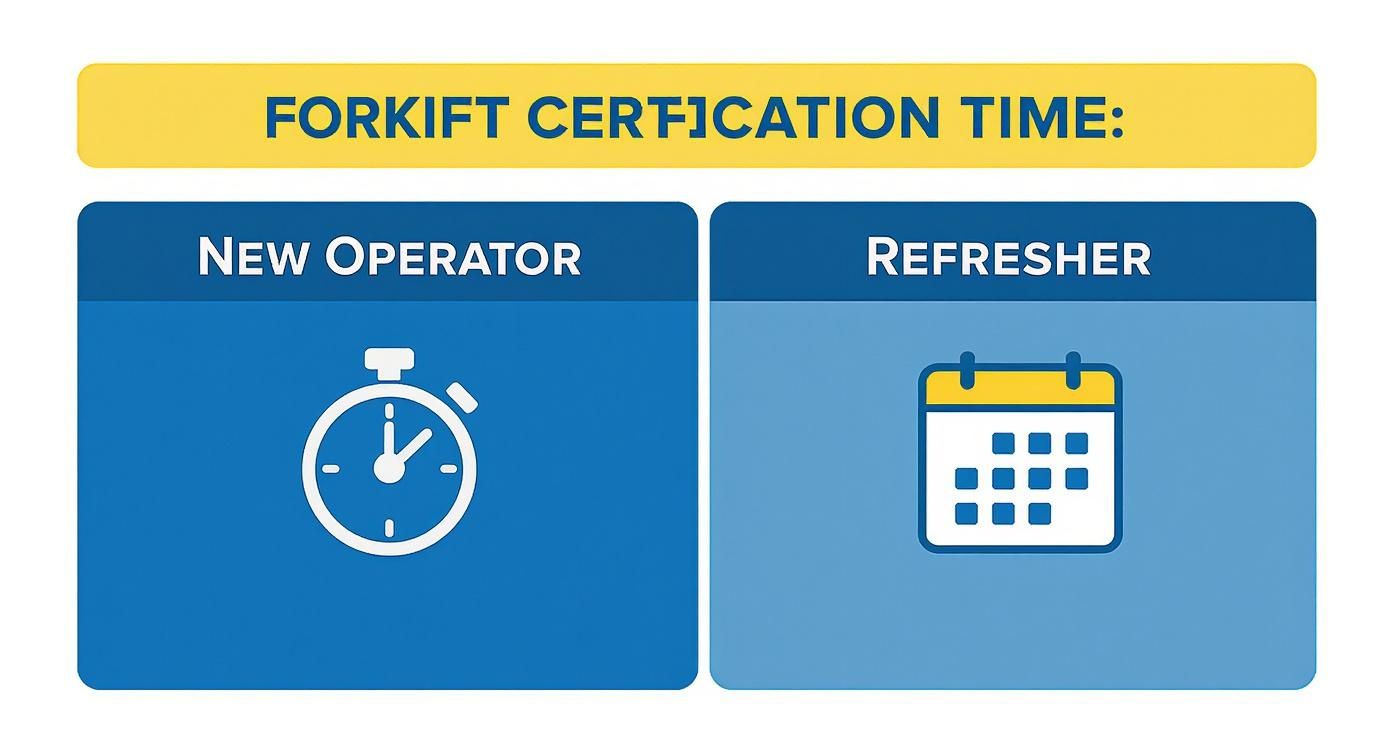
As you can see, that initial certification is a small but critical time investment. Renewals are designed to be a much quicker check-in to ensure everyone, new or experienced, is operating safely and efficiently.
The Two Core Stages of Forklift Certification
Think of getting your forklift certification a lot like getting your driver's license. You don't just take one test and call it a day. OSHA requires a two-part process to make sure every operator has both the book smarts and the real-world skills to handle heavy machinery safely.
It’s a system designed to build a solid foundation of knowledge first, then prove you can apply it in a live work environment.
Stage 1: Formal Instruction
This is the "written test" part of the journey. In this first stage, you learn the essential rules of the road for operating a forklift. This isn't just about memorizing facts; it's about understanding crucial safety procedures, how different lifts work, and how to spot workplace hazards before they become accidents.
You can get this foundational knowledge in a traditional classroom or through a flexible online course.
This phase is all about building a strong base of safety knowledge. In-person training sessions typically wrap this up in about 6 to 8 hours, often blending the classroom work with the hands-on practice that comes next.
According to OSHA's standard 29 CFR 1910.178(l)(2)(ii), forklift operator training must consist of a combination of formal instruction (e.g., lecture, discussion, interactive computer learning, video), practical training (demonstrations performed by the trainer and exercises performed by the trainee), and an evaluation of the operator's performance in the workplace.
Stage 2: Practical Evaluation
Once you’ve passed the knowledge portion, it's time for your "road test." This is the practical, hands-on evaluation, and it’s absolutely critical. An OSHA-qualified trainer has to watch you operate the exact type of forklift you’ll be using on the job, in your actual workplace.
You’ll need to show you can handle the machine safely, manage loads correctly, and maneuver with confidence.
Both of these stages are non-negotiable. If you complete an online course but skip the hands-on evaluation, you are not certified. As you look at different training options, getting insights into choosing the right certification program can help you understand what a complete, compliant program should include.
When you successfully pass both parts, you’ve earned a certification that meets OSHA standards. To dig deeper into what this involves, check out our guide on forklift safety requirements.
Online Training vs. In-Person Classes
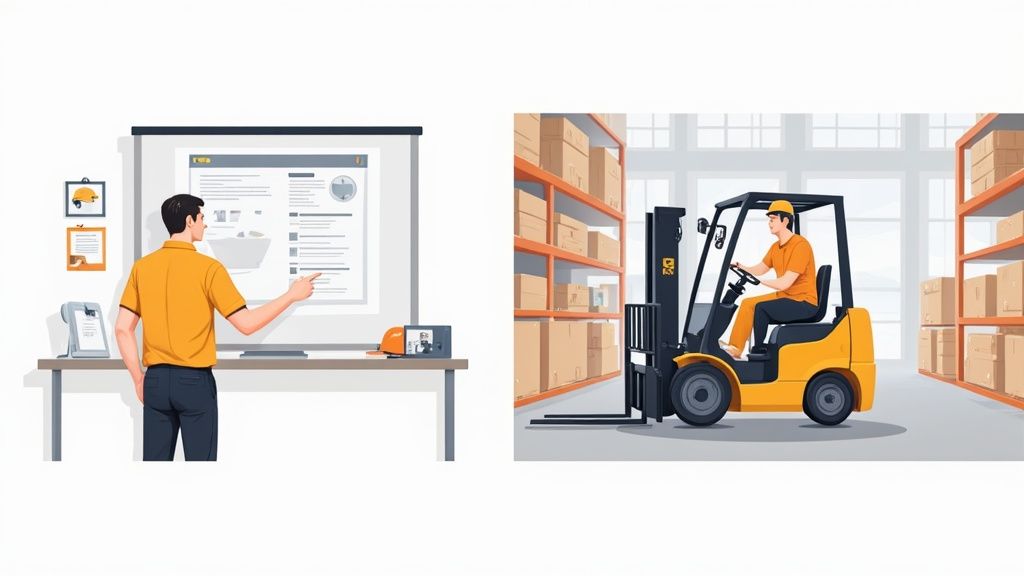 One of the biggest factors determining how long your forklift certification will take is deciding between online and in-person training. There’s no single "best" way—it all comes down to your learning style, your schedule, and how fast you need to get it done. Each path has its own rhythm.
Think of traditional in-person classes like a one-day workshop. Everything you need is packed into a single, structured session that usually lasts a full day. This approach is fantastic for getting a whole crew certified at once or for people who learn best with a live instructor they can pepper with questions.
The In-Person Advantage
The main draw of in-person training is that it's an all-in-one deal. You knock out the classroom learning and the hands-on evaluation in one coordinated push, so there's no need to schedule the two parts separately. If you can clear a full day, this is often the most direct route from zero to certified.
- Structured Learning: The curriculum is set and led by an instructor, keeping everyone on the same page.
- Immediate Feedback: Got a question? You get an answer on the spot from a professional trainer.
- Team Cohesion: Perfect for training a whole team together, making sure everyone gets the exact same information at the same time.
The Flexibility of Online Training
On the flip side, online forklift certification gives you unbeatable flexibility for the classroom portion of the training. Modern courses, like the ones we offer at Flat Earth Equipment, let you tackle all the formal instruction at your own pace. You can power through it in one session or chip away at it over a few nights.
The best online programs use interactive tools to make sure the information sticks. Good use of things like creating online quizzes for corporate training can really help solidify your knowledge before the hands-on test.
Key Takeaway: Online training splits the "knowing" from the "doing." You master the safety rules and theory on your own time, then schedule the required in-person skills evaluation with a qualified supervisor. This is a game-changer for self-starters and businesses with unpredictable schedules.
How Long Your Forklift Certification Is Valid

Getting your forklift certification is a huge step, but it’s not a one-and-done deal. It’s better to think of it like a driver's license—it needs to be renewed periodically to prove you're still a safe, competent operator.
OSHA is very clear on this: your forklift certification is good for three years. Once that time is up, you'll need to go through a recertification process. This usually means a quick refresher on safety rules followed by another hands-on skills evaluation. The goal is simple: to make sure your skills are still sharp and you’re up-to-date with current safety standards.
But the three-year mark isn't the only time you might need to hit the books again. Certain on-the-job events can trigger an immediate need for retraining, long before your card is due to expire.
Triggers for Early Recertification
Staying certified is all about showing consistent, safe performance. Because of this, OSHA requires employers to re-evaluate their operators and provide retraining if specific situations pop up. These triggers are designed to tackle safety risks as they happen, not just when the calendar says it's time.
You'll need to be re-evaluated if you are:
- Involved in an accident or even a near-miss while on the forklift.
- Seen operating the forklift unsafely, like going too fast or handling a load improperly.
- Assigned to a different type of forklift that has significantly different controls or capabilities.
- Working in a substantially changed environment, like a warehouse that just went through a major layout change.
Essentially, your certification lasts three years, but it's conditional. Operators must prove they can continue working safely. If not, they'll need to pass refresher training and another skills test to keep their credentials.
This performance-based system just makes the workplace safer for everyone. For operators in the Lone Star State, it also pays to know the local rules; you can find more details on Texas forklift certification requirements to ensure you're fully compliant.
Variables That Impact Your Certification Timeline
There's no single answer to "how long does forklift certification take?" While the average is one to two days, several factors can stretch or shrink that timeline. Think of it less like a fixed appointment and more like a road trip—your arrival time depends on where you start, what you're driving, and the traffic along the way.
The biggest variable by far is your prior experience. A veteran operator coming back for a quick recertification might just need a couple of hours to catch up on safety rules and demonstrate their skills. A total beginner, on the other hand, has to learn everything from scratch—from basic controls to the physics of balancing a heavy load.
The complexity of the forklift itself is another major factor. Getting certified on a standard electric pallet jack is a world away from mastering a specialized rough-terrain telehandler with multiple attachments. Each machine has its own quirks and safety protocols that demand dedicated training time.
Key Factors Shaping Your Timeline
Beyond your skill level and the type of lift, simple logistics often determine whether you get certified in a day or if it takes a week.
Three main components to keep in mind are:
- Training Format: In-person classes bundle everything into a structured day. An online course gives you flexibility for the theory part, but your final timeline hinges on scheduling the separate hands-on evaluation.
- Class Size: One-on-one training or a small group means more direct attention and lets you get through the practical tests faster. In a large class, you'll spend more time waiting for your turn.
- Instructor Availability: The final, mandatory step is the in-person evaluation. Finding a time that works for both you and a qualified evaluator can be a real bottleneck, especially in a busy warehouse or job site.
The bottom line is that your personal timeline is a mix of your skills, the machine's complexity, and simple logistics. Planning ahead, especially for the hands-on evaluation, is the best way to avoid unnecessary delays and get certified efficiently.
How to Get Your Forklift Certification Faster
If you're on a tight deadline, getting your forklift certification doesn't have to be a long, drawn-out process. A smart approach can cut down the timeline significantly. The trick is to break the process into a couple of key steps and handle them efficiently, dodging the usual delays that slow most people down.
Your best first move is to go with a blended training model. Knock out the classroom portion with an online course. This lets you cover all the required safety theory and operational knowledge on your own time—before you even have to think about scheduling the hands-on driving test. You’ll show up to your practical evaluation with all the knowledge already in hand, ready to prove you know your stuff.
Streamlining the Evaluation Process
So where's the most common holdup? Scheduling that in-person evaluation. A little proactive planning here makes all the difference.
- Coordinate Early: The moment you start your online theory, get in touch with your employer or a qualified evaluator. Don't wait until you've finished the course to try and book a time slot.
- Group Up: For businesses, certifying several operators at once is a huge time-saver. You can condense all the hands-on evaluations into a single, focused session instead of juggling a bunch of separate appointments.
This game plan puts you in control of the timeline by eliminating the "hurry up and wait" part of the process. When you complete the theory on your own and schedule the evaluation ahead of time, you set the pace.
You can learn more about building a strong foundation with our OSHA-compliant forklift safety training options. Following these steps will help you get certified quickly and correctly.
Common Questions About Forklift Certification
Even after laying out the process, a few questions always seem to pop up. Let's tackle some of the most common ones so you're completely clear on how all this works.
Is a Forklift License the Same as a Certification?
This one trips a lot of people up. While you’ll hear the terms used interchangeably, OSHA requires “certification,” not a state-issued “license” like you’d get for a car.
The key difference is that certification is employer-specific. It's formal proof that you were trained and evaluated on the exact equipment you'll be using at your specific job site. Think of it less like a driver's license and more like a specialized permit for that workplace.
How Much Does Forklift Certification Cost?
The cost really depends on the training path you take. Online courses covering the theory portion are usually pretty affordable, often landing somewhere between $50 and $100.
Comprehensive in-person programs that include hands-on training and the final evaluation can run anywhere from $150 to $400. The good news is that many employers cover this cost for their workers as a standard part of their safety program.
What Does Forklift Recertification Involve?
Recertification is essentially a condensed refresher course required every three years to keep your skills sharp and up-to-date.
It involves a quick review of current safety standards and operational best practices, followed by another practical skills evaluation to confirm you're still operating safely and efficiently.
Ready to get your team certified without the hassle? Flat Earth Equipment offers OSHA-compliant online training that gets the classroom portion done in hours, not days. Check out our forklift training programs and get started today.