Let's be blunt: forklift certification isn't optional. It's a legal requirement mandated by OSHA, and the responsibility lands squarely on the employer's shoulders. The whole process boils down to a mix of classroom-style learning, real-world hands-on training specific to your workplace, and a final evaluation to prove the operator actually knows what they're doing.
Decoding OSHA’s Forklift Certification Mandate
It's easy to get lost in the weeds of compliance, so let's cut right to the chase. The heart of forklift safety in the U.S. is OSHA's standard for powered industrial trucks, specifically 29 CFR 1910.178. This isn't just a friendly suggestion—it's federal law that requires every employer to make sure every single operator is properly trained and certified.
The best analogy is getting a driver's license. You wouldn't just toss the keys to a teenager without them first learning the rules of the road, getting hours of practice behind the wheel, and passing a driving test. OSHA sees it the same way, and a forklift in a busy warehouse can be a lot more dangerous than a car on the street.
Who's responsible for making this happen? You are. The employer is the official certifying body. That means it’s on you to create, run, and document a training program that proves each operator is competent to use the specific machines they'll be on, in your unique environment.
You can see OSHA's own resource page for powered industrial trucks right here.
Think of that page as your central hub. It gives you direct access to the standards, hazard info, and safety solutions that form the backbone of your legal obligations.
The Foundation of a Compliant Program
OSHA built its framework on a simple, three-part structure. It's designed to build competence step-by-step. Any program you run must include these three pillars.
At its core, a complete and compliant certification program must have three distinct parts. This isn't just a suggestion; it's a mandatory framework designed to build knowledge and skill progressively, ensuring operators are truly competent before they start moving loads.
| Training Component | Description | Key Objective |
|---|---|---|
| Formal Instruction | Classroom-style learning, covering theory, regulations, and equipment principles. | To build a solid foundation of knowledge about forklift operation, safety rules, and hazard identification. |
| Practical Training | Hands-on exercises and tasks performed on the actual forklift in the workplace. | To translate theoretical knowledge into real-world skill and muscle memory under direct supervision. |
| Performance Evaluation | An observed skills test where an operator demonstrates their ability to work safely and efficiently. | To verify and officially document that the operator is competent to perform their job duties safely. |
This three-pronged approach guarantees that operators don't just memorize the rules but can actually apply them when it counts. Since this standard was put in place back in 1999, every U.S. employer has been required to follow this process.
Here's a common trap: assuming a certification from a previous job is still valid. OSHA is crystal clear on this—certification is employer-specific. When you hire a new operator, you must always retrain and re-evaluate them for your specific site and equipment. No exceptions.
Ultimately, getting these fundamentals right is the first step toward building a true safety-first culture. For a deeper dive into creating a safe workspace, check out our comprehensive guide on forklift safety. It lays the groundwork for a program that doesn't just check a legal box, but actively protects your team.
The Three Pillars of Effective Forklift Training
A compliant forklift certification is so much more than a wallet card. It’s the official proof that an operator has truly mastered the three-stage learning process that OSHA demands. Think of it like learning to drive a car: you don't just get a license after reading the driver's manual. You read the book, get behind the wheel with an instructor, and then pass a road test.
Forklift training follows that exact same logic to build real, lasting competence. An operator isn't truly certified until they've completed all three pillars: formal instruction, practical hands-on training, and a final performance evaluation. If you skip a step, you're not just compromising safety—you're leaving your company non-compliant and wide open to serious liability.
Pillar 1: Formal Instruction
This is the "classroom" phase, the foundation where operators learn the core principles of safe forklift operation. All the practical skills they learn later are built right on top of this theoretical knowledge. This can be done in a few different ways, like an instructor-led lecture, an interactive online course, or even training videos.
The goal here is to make sure operators deeply understand the machine they're using and the environment they're in. For anyone looking to build out their program, resources on creating an effective forklift training video guide can be a huge help. No matter how you deliver it, this instruction has to cover some critical topics specific to your trucks and your workplace.
Key Topics for Formal Instruction:
- Vehicle Stability: Getting a gut feeling for the "stability triangle" and the things that cause tip-overs, like going too fast into a turn or misjudging a load's center.
- Load Capacity and Data Plates: Teaching operators how to read and actually understand the forklift's data plate—knowing its absolute max lifting capacity is non-negotiable.
- Operating Instructions: Covering the specific knobs, levers, and functions for the exact forklift models you have on the floor.
- Workplace Hazards: Walking through the unique dangers of your site, from ramps and uneven floors to blind corners and busy pedestrian aisles.
- Refueling and Recharging: Detailing the step-by-step safe procedures for swapping propane tanks, handling fuel, or hooking up industrial batteries for charging.
This foundational knowledge is the mandatory first step before anyone gets behind the wheel.
The OSHA certification process is a straight line: you start with instruction, move to hands-on practice, and finish with a final evaluation.
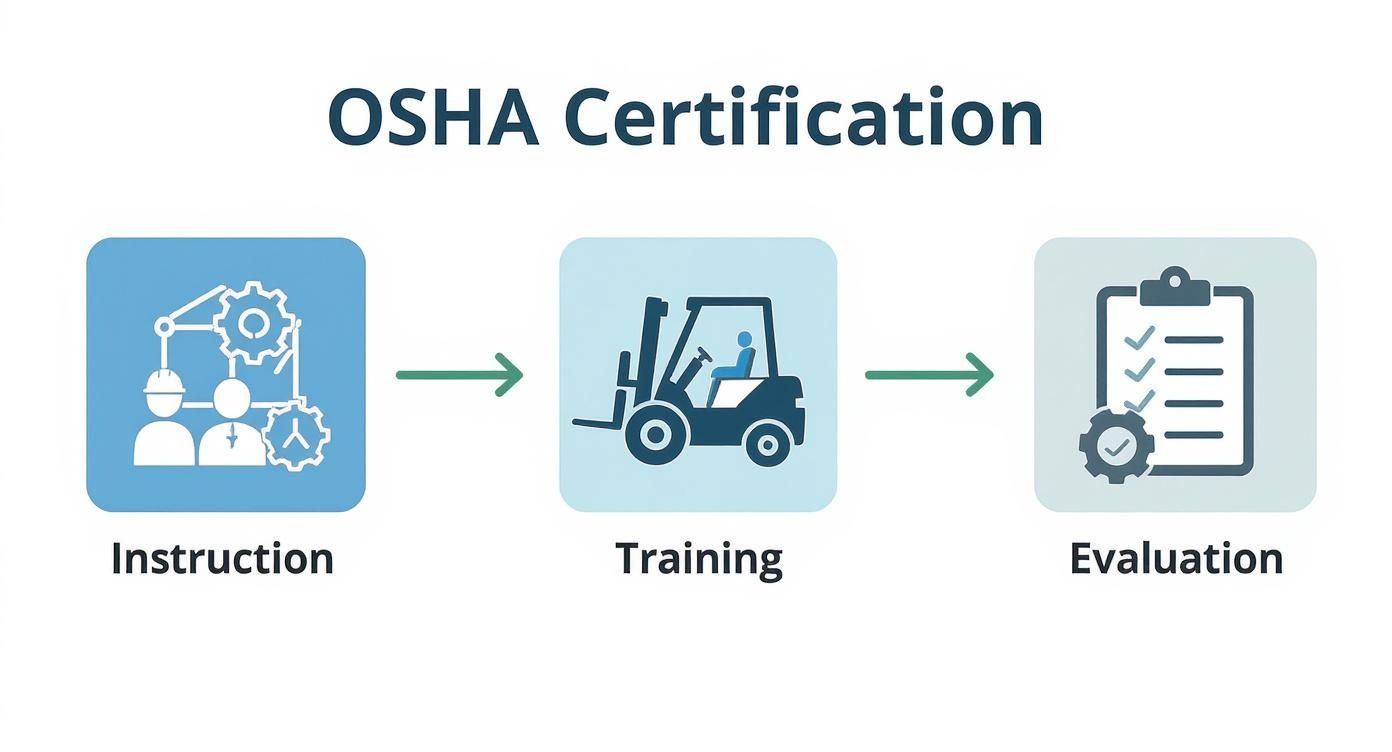
This graphic really drives home the point that certification is a journey, not a single event. Each stage builds on the one before it to create a genuinely proficient operator.
Pillar 2: Practical Training
This is where the rubber meets the road—or in this case, the tires meet the warehouse floor. Practical training is all about hands-on exercises where the trainee operates a forklift under the watchful eye of a qualified trainer. And here's the critical part: it must happen at the actual worksite on the exact type of forklift they'll be using every day.
A certification someone earned on a stand-up reach truck in another company's warehouse means nothing for operating your sit-down counterbalanced forklift. This site-specific rule is probably one of the most misunderstood parts of OSHA's requirements.
OSHA is crystal clear on this: Operators have to be trained in the environment where they will actually be working. This is the only way to prepare them for the unique layout, challenges, and hazards of your specific facility. An online-only course can never fulfill this requirement on its own.
During this phase, trainees run through the same tasks they’ll do during a normal shift. They’ll practice maneuvering down tight aisles, stacking pallets at different heights, and navigating around common obstacles. It’s the bridge between knowing what to do and being able to actually do it safely and efficiently when it counts.
Pillar 3: Performance Evaluation
The final pillar is basically the operator's driving test. A qualified evaluator watches the operator perform their normal job duties in the real work environment to confirm they can do everything safely. This isn’t a multiple-choice quiz; it’s a live demonstration of skill.
The evaluation is the ultimate check to see if the operator can apply the theory from their formal instruction and the skills they practiced during their hands-on training.
Evaluation Checklist Items:
- Pre-Shift Inspection: Can the operator correctly perform a full pre-use inspection and spot potential safety problems?
- Maneuvering Skills: Do they handle the forklift smoothly and at a safe speed, especially when turning or reversing in tight quarters?
- Load Handling: Can they pick up, move, and place loads securely without damaging product, racking, or the equipment itself?
- Hazard Awareness: Are they actively aware of their surroundings, including pedestrians, intersections, and other workplace dangers?
Only after an operator nails this performance evaluation can an employer officially sign off on their certification. This three-pillar system ensures that every certified operator has the knowledge, the skill, and the proven ability to handle their machine responsibly, making the entire workplace safer for everyone.
Your Legal Duties as an Employer

When it comes to forklift certification, there’s one truth that stands above all else: the buck stops with you, the employer. You aren't just arranging for training; you are the official certifying body. This is a serious legal duty, and you can't hand it off to an outside training company or an online-only course.
Think of it this way: a third-party trainer is like a driving school. They teach the rules of the road and the mechanics of driving, but they don't issue the actual license. The state does. In the world of powered industrial trucks, your company is the state. You are legally on the hook for creating, carrying out, and documenting a complete certification program.
That means you’re ultimately responsible for making sure every single operator is competent to run the specific forklifts they’ll be using, right there in the unique environment of your facility.
The Employer as the Certifying Body
As the final authority on certification, your main job is to guarantee the training is both comprehensive and site-specific. An operator's certification from their last job doesn't carry over. It’s up to you to personally verify that every new hire, no matter how much experience they claim to have, can safely handle your equipment in your workplace.
This isn't just a handshake deal. This verification process requires you to oversee and document several key actions.
Your core responsibilities include:
- Developing a Program: You must create or adopt a training program that hits all three of OSHA's required pillars: formal classroom instruction, practical hands-on training, and a final performance evaluation.
- Designating a Qualified Trainer: The person leading the training and evaluation must have the necessary knowledge and experience to properly train operators and judge their competence.
- Site-Specific Training: Your practical training must address the unique hazards of your facility. Think specific aisle widths, tricky ramp inclines, or heavy pedestrian traffic patterns.
- Issuing the Certification: You must formally certify that each operator has successfully passed all training and evaluation components before they operate a forklift without supervision.
The statistics on forklift incidents really drive home how critical these duties are. Every year in the U.S., forklift accidents lead to tens of thousands of serious injuries and, tragically, an average of 87 deaths.
Critical Recordkeeping Requirements
Proper documentation is your best defense during an OSHA inspection and a non-negotiable part of your legal duties. If you can’t prove an operator was certified, in the eyes of the law, it simply never happened.
Your certification records are the official, legal proof that you have fulfilled your training obligations. Without them, your company is exposed to significant fines and liability in the event of an accident.
OSHA demands that you keep a written record for every single certified operator. This isn't just a signed piece of paper; it must contain specific details to be compliant.
What Each Certification Record Must Include:
- Operator's Name: The full name of the employee who was trained and certified.
- Date of Training: The date the formal and practical training sessions were finished.
- Date of Evaluation: The specific date the operator passed their final performance evaluation.
- Identifier of the Evaluator: The name and title of the qualified person who conducted the training and observed the final evaluation.
These records need to be readily accessible if an inspector shows up. While OSHA doesn't provide an official form, keeping a detailed and consistent log for your entire team is a non-negotiable best practice. Understanding these obligations is crucial, and state-specific resources can help; for example, you can learn more about Texas forklift safety regulations on our site. This ensures you’re not just checking a box for compliance but are actively building a safer workplace.
When Do My Operators Need to Be Recertified?
Getting an operator certified isn't a one-and-done deal. Think of it less like a diploma on the wall and more like a pilot's license—it requires regular check-ins to ensure skills stay sharp and safe. OSHA is very clear on this: you must formally re-evaluate every operator’s performance at least once every three years to keep their certification active.
This three-year mark is the absolute maximum time you can let pass between evaluations. It's a critical safety net, designed to catch any bad habits or skill decay before they lead to an incident. But here's a mistake I see all the time: managers treating that three-year deadline as the only time they need to worry about retraining. That's a dangerous assumption.
Plenty of situations demand immediate retraining, long before the three-year clock runs out. Ignoring these triggers isn't just a compliance issue; it’s a gamble with your team's safety.
The Mandatory Three-Year Evaluation
That three-year check-in isn't just a casual conversation or a quick once-over. It needs to be a formal performance evaluation, conducted with the same seriousness as the operator's very first practical test.
A qualified evaluator has to watch the operator in their actual work environment, running the equipment they use every day. The whole point is to confirm they can still operate the lift safely, manage loads correctly, and navigate your facility without putting anyone at risk. If they pass, their certification is good for another three years.
Don't think of this as just stamping a new date on a piece of paper. It’s an active assessment to prove an operator’s skills haven't faded and that complacency hasn't crept in. Complacency is a killer in warehouses, and this evaluation is one of your best defenses against it.
Red Flags That Trigger Immediate Refresher Training
Beyond that standard three-year cycle, certain events legally require you to pull an operator off their forklift for immediate refresher training. These aren't just suggestions; they are spelled out in OSHA's standard, 1910.178.
Refresher training is a targeted fix. You don't necessarily have to put them through the entire certification course again. Instead, it should focus specifically on correcting the knowledge gap or unsafe behavior that was identified.
OSHA lays out a few non-negotiable triggers for this:
- Involvement in an Accident or Near-Miss: If an operator is part of any incident—even a "near-miss" where an accident was just barely avoided—retraining is mandatory. This covers everything from bumping the racking to incidents involving injuries or property damage.
- Unsafe Operation: This one is straightforward. If you or a supervisor sees an operator driving recklessly—speeding, taking corners too fast, carrying an unstable load—they need to be retrained right away.
- A Failed Evaluation: If an operator can't pass their three-year evaluation or any other performance spot-check, their operating privileges are suspended. They can't get back on the lift until they've completed remedial training and passed a new evaluation.
- Assignment to a Different Type of Truck: Just because someone is certified on a sit-down counterbalance forklift doesn't mean they're qualified to hop on a narrow-aisle reach truck. Every different class of powered industrial truck requires its own specific training and evaluation.
- Changes in the Workplace: Did you reconfigure the aisles? Install new types of racking? See a big jump in foot traffic? Any significant change to the work environment means all affected operators need retraining on how to navigate the new hazards safely.
Knowing these triggers is fundamental to running a safe, compliant operation. It turns forklift certification from a static document filed away in a cabinet into what it should be: a living process of continuous improvement and risk management.
Choosing the Right Training Approach
https://www.youtube.com/embed/IBFLmpgPjvE
When you start digging into forklift training, the options can feel like a minefield. You've got everything from quick online courses promising instant certification to traditional, instructor-led classes. But which path actually checks all of OSHA's boxes?
The most common trap is the "online-only" certification. These are often sold as a fast, cheap, and easy fix, but they're a huge compliance risk. While online learning is fantastic for covering the classroom part of training, it can never legally stand on its own for a full certification.
OSHA couldn't be clearer on this: real certification demands hands-on, practical training and a live performance evaluation. No video or quiz can teach an operator how to feel the machine's center of gravity shift, navigate a tight aisle with a heavy load, or react to a sudden obstacle. That only comes from time in the seat.
The Blended Learning Gold Standard
So what’s the answer? A blended or hybrid model is the undisputed gold standard for effective, modern, and fully compliant forklift training. It takes the best of both worlds—the efficiency of online learning and the irreplaceable value of hands-on practice.
This approach splits the training into two logical phases:
Online Formal Instruction: Operators complete the “classroom” portion at their own pace. This covers all the theory—safety rules, forklift mechanics, and hazard recognition—making sure everyone gets the same solid base of knowledge.
In-Person Practical Training: Once they’ve got the theory down, trainees head to the warehouse floor. Under the watchful eye of a qualified trainer, they get behind the wheel of the exact machine they’ll use every day, in their actual work environment.
This structure guarantees you meet every single OSHA requirement without cutting corners. It's efficient, easy to scale for your whole team, and, most importantly, completely defensible if an inspector shows up.
Comparing Forklift Training Formats
Let's put the different training models head-to-head to see how they stack up against OSHA's three mandatory components. This simple breakdown makes it obvious why a hybrid approach is the only truly bulletproof choice.
Comparing Forklift Training Formats
| OSHA Requirement | Online-Only Courses | Hands-On Training | Hybrid Model |
|---|---|---|---|
| Formal Instruction | Yes | Yes | Yes |
| Practical Training | No | Yes | Yes |
| Performance Evaluation | No | Yes | Yes |
| OSHA Compliance | Non-Compliant | Compliant | Fully Compliant |
As you can see, relying on an online course by itself leaves massive, dangerous gaps in your compliance. To get the most out of your program, it's worth exploring different effective ways to deliver corporate training that keep your team engaged and reinforce safety from every angle.
At the end of the day, you, the employer, are the one doing the certifying. When you sign that certificate, you are making a legal statement that you have personally verified the operator is competent in all three training stages. A blended approach gives you the framework and the confidence to sign that document honestly.
By investing in a proper hybrid training model, you're not just checking a box. You’re building a real safety culture that protects your people, your equipment, and your business from the steep costs of non-compliance and accidents.
A Practical Checklist for OSHA Compliance
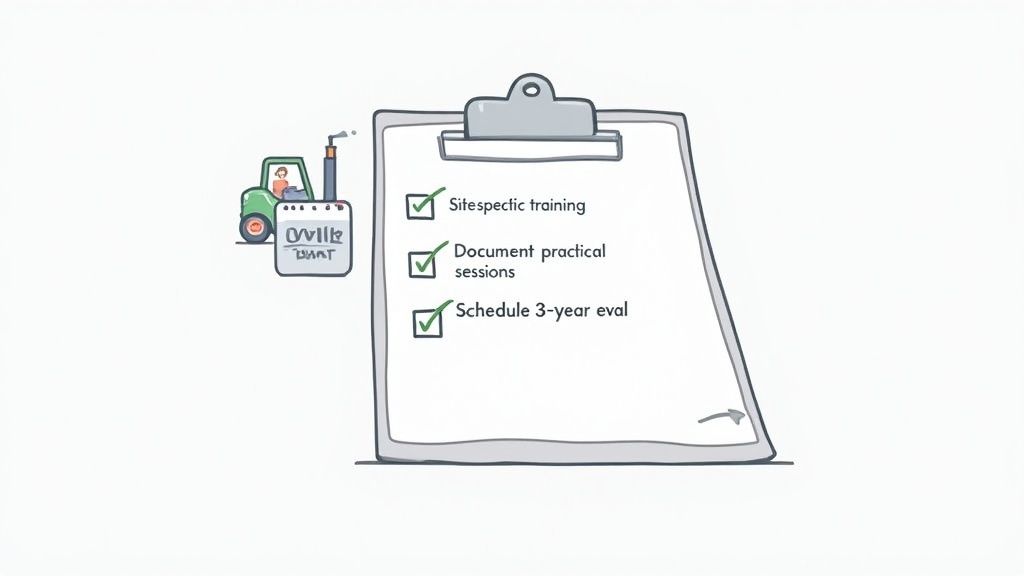
Alright, let's turn all this theory into action. Knowing the rules is one thing, but actually implementing them is where safety gets real.
Think of this as your battle-tested roadmap for OSHA compliance. It breaks down the entire certification lifecycle into manageable steps you can use to check your current program or build a solid one from scratch.
Phase 1: Initial Training and Certification
This is ground zero. It’s everything you need to do to take a brand-new operator and get them safely and legally behind the wheel. Get this part right, and you've built a strong foundation.
- Build a Site-Specific Training Plan: Don't just download a generic PDF. Your plan has to tackle the unique hazards of your warehouse, the specific trucks your team uses, and the actual loads they'll be moving.
- Handle the Formal "Classroom" Instruction: Before anyone even touches a forklift, they need to sit down and learn the fundamentals. This covers the OSHA rules, the physics of forklift stability, proper load handling, and how to spot danger.
- Conduct Hands-On, Supervised Practical Training: This part is absolutely critical. Your trainee needs to get real seat time on the exact forklift they’ll be operating, in your actual work environment, with a qualified trainer watching every move.
- Perform the Final Performance Evaluation: This is the final exam. A qualified person must watch the operator perform their job duties in a real-world setting and officially sign off on their skills. This is the moment they go from "trainee" to "certified operator."
Here’s a common trip-up: thinking an online certificate is the end of the story. It's not. Remember, you, the employer, are the one doing the certifying. That final, in-house evaluation is what makes it official in OSHA's eyes.
Phase 2: Documentation and Recordkeeping
Let’s be blunt: if you didn’t write it down, it never happened. Solid recordkeeping is your number one defense in an OSHA audit and a fundamental legal requirement.
Your records need to be buttoned up and easy to access. To see how this fits into a bigger safety picture, check out our guides on building comprehensive workplace safety protocols.
For Every Single Certified Operator, Your File Must Have:
- The operator's full name.
- The date they completed their training.
- The date they passed their final evaluation.
- The name of the trainer(s) and the evaluator(s).
Phase 3: Ongoing Compliance and Recertification
Certification isn't a "one-and-done" deal. It’s a living process. Staying compliant means keeping a close watch on your operators and knowing when it's time for a refresher.
- Schedule Re-Evaluations Every 3 Years: Put it in your calendar. Every operator must have their performance formally re-evaluated at least once every three years to keep their certification valid.
- Watch for Retraining Triggers: You need to provide refresher training immediately if an operator is involved in an accident or a near-miss, is seen driving unsafely, or gets assigned to a completely different type of forklift.
- Update Training When Your Workplace Changes: Did you rearrange the warehouse? Get a new type of racking? Introduce a new piece of equipment? Any significant change means all affected operators need retraining to handle the new environment safely.
Stick to this checklist, and you'll build a system that doesn't just check a box for OSHA. You'll be creating a genuine culture where everyone understands that safety comes first.
Your Top Questions Answered
When you're trying to keep up with OSHA's forklift rules, a few key questions always seem to pop up. Let's get right to the practical answers you need.
How Long Is a Forklift Certification Good For?
An operator's certification is valid for a maximum of three years. After that, they’ll need a formal performance re-evaluation to get it renewed.
But don't just circle a date on the calendar three years out. That three-year clock can be cut short. OSHA requires immediate refresher training and re-evaluation if an operator:
- Gets into an accident or has a near-miss.
- Is spotted driving the forklift in an unsafe way.
- Needs to operate a different kind of forklift.
- Has to adapt to a major change in the workplace, like a new warehouse layout.
Can I Take My Certification to a New Job?
Nope. This is a big one that trips people up. Forklift certification is employer-specific and site-specific. Think of it like a key card for your office building—it won’t get you into the building across the street.
Your new boss is legally required to run you through their own training and evaluation process. They have to confirm you can safely operate their equipment in their unique environment before they can issue their own certification. Your previous experience is valuable, but it doesn't transfer over.
What’s the Minimum Age to Drive a Forklift?
The hard-and-fast rule from the federal government is 18 years old.
There is zero wiggle room here. OSHA makes this crystal clear, and there are no exceptions for family businesses or any other scenario. Putting anyone under 18 behind the wheel of a forklift is a major violation of federal labor laws that comes with serious legal and financial consequences for the employer.
Getting these details right is the first step toward running a safe, compliant, and efficient operation.
Ready to build a fully compliant, hassle-free training program? Flat Earth Equipment offers OSHA-compliant online forklift certification that combines interactive learning with the flexibility your team needs. Get your operators trained and certified in hours, not days, with our bilingual, QR-verifiable courses. Ensure your team is safe and your business is protected by visiting https://flatearthequipment.com to get started today.